Philadelphia
I'd Like to Apologize to Every Teacher I Ever HadPhiladelphia is the central urban setting of Tony Danza’s year as a tenth-grade English teacher at Northeast High. It gives the narrative its geography, its social pressures, and its recurring contrast between public need and private advantage: a city of enormous schools, entrenched challenges, cultural energy, and students whose opportunities are shaped by whether institutions can make room for them. Through Philadelphia, the book turns one teacher’s classroom experience into an inquiry into what an American city owes its children—and what one person can do when the scale of the problem exceeds any individual effort.
City and School Setting
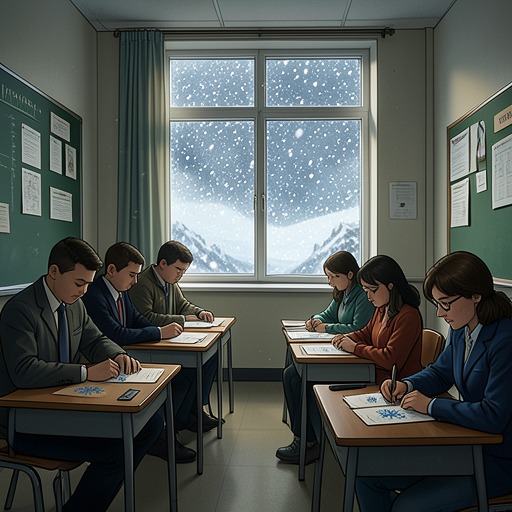
Philadelphia is introduced as the home of Northeast High, an inner-city public high school and the largest high school in the city. The campus dates back to the 1840s, while its current brick building was erected in 1953 and resembles a postwar factory, complete with a towering smokestack. Its scale is almost a city within the city: three stories, trailers, several sports fields, its own football stadium, a huge cafeteria, cavernous gyms, and even a Philadelphia police station. The physical magnitude of the school establishes the institutional world Tony Danza must enter, while also suggesting why ordinary teaching is so easily overwhelmed by logistics, discipline, and competing demands.
The school’s internal organization reinforces this sense of urban magnitude. Northeast High is divided into eight Small Learning Communities, each occupying a different section where students take their core classes. The Arts and Education Small Learning Community includes teachers of English, music, drama, art, mathematics, and social studies, and is led by veteran English teacher Lynn Dixon. Its daily meetings expose the administrative labor surrounding classroom instruction: deadlines, district mandates, seminars, technology training, planning requirements, and grading procedures. Philadelphia therefore appears not only as a physical location but as a network of systems that teachers must navigate before they can teach.
Urban School Life and Public Pressure
The city’s educational pressures become visible during the Northeast High truancy patrol. Tony Danza is assigned to spend the first hour of the school day circling campus, confronting late students, escorting stragglers, telling smokers to extinguish their cigarettes, and redirecting students who are walking away from school. Even after the bell rings, many students remain outside; some race to class, some dawdle, and others gather in an alley off Algon Street. The scene makes attendance a daily struggle rather than an abstract statistic, and it shows how Philadelphia’s teachers and administrators are forced to spend time securing the conditions in which education might occur.
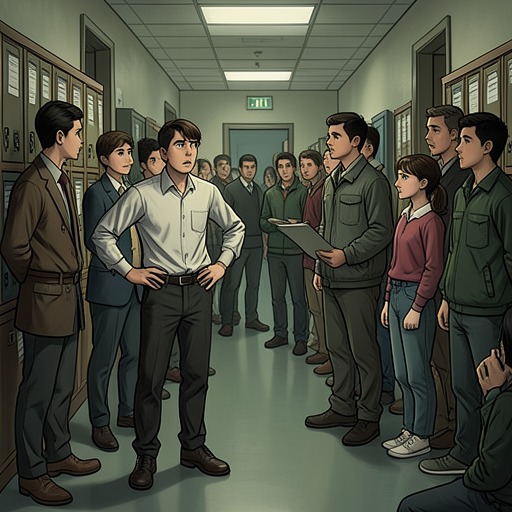
The book also records the city’s racial and social tensions without treating them as distant policy issues. Matt, a white student and football linebacker, becomes involved in repeated fights after a friend is attacked and is later badly beaten by four African-American students. When his parents come to school for a counseling meeting, a confrontation with a group of Black girls in the corridor escalates into insults, racial epithets, and shouting. Matt’s father leaves convinced that his son’s complaints about Northeast High are justified, while Tony Danza warns him not to reinforce that conclusion, insisting that the girls’ language belongs to a cultural environment rather than proving that the school’s students are inherently threatening. Philadelphia is thus presented as a place where school life carries the city’s racial divisions into hallways, disciplinary judgments, family conversations, and competing interpretations of danger.
The school-uniform debate similarly turns ordinary clothing into a question of public authority, gender, cost, distraction, and fairness. Students argue over whether what girls wear should be regulated and whether anyone should be punished because other students find particular clothing distracting. The discussion shows Philadelphia’s school policy as a lived controversy, not merely an administrative rule: students test the language of responsibility against their own experiences, while the classroom becomes a miniature civic forum.
Culture, Opportunity, and Civic Action
Philadelphia’s cultural life repeatedly enlarges the students’ sense of what lies beyond their immediate routines. Tony Danza organizes Extravadanza, a student variety show involving roughly two hundred performers from Northeast High and two other area high schools. The proceeds are intended to air-condition the library, so the event joins artistic expression to a practical institutional need. When the 2010 Haiti earthquake brings images of collapsed schools, dazed orphans, and homeless families into the classroom through the Internet and television, students decide to use the show to raise money for earthquake relief. They create signs and donation buckets, collect contributions before, during, and after the performance, and draw even Al G and Matt into the effort after Tony Danza offers to match what they raise. Philadelphia becomes a site where local performance is connected to international suffering and where students move from spectatorship to civic action.
The city also provides routes into public recognition for students whose abilities might otherwise remain unseen. Alex becomes Northeast High’s poet laureate after his poetry is read in an office and praised by teachers; he later competes in the Philly Youth Poetry contest, travels with the team to Los Angeles, and writes poems for UnLitter Us, a Philadelphia public-service campaign against litter. Poetry gives him a reason to attend school and a form in which he can be recognized as exceptional. The contrast matters: he is not defined by athletics, science, mathematics, or student government, but his poetry makes him a “rock star.” Philadelphia’s arts culture therefore functions as an educational lifeline rather than an ornamental extra.
Philadelphia as a Network of Relationships
The city’s institutions and neighborhoods shape the adults’ relationships as much as the students’ lives. Tony Danza lives temporarily in Northern Liberties, a neighborhood undergoing gentrification and filled with galleries, bars, and restaurants. From his apartment’s east-facing window, he watches the elevated train pass and remembers growing up in Brooklyn, where an elevated train ran along Pitkin Avenue. That view connects his childhood to the students he is now expected to teach: Philadelphia becomes the place where a former actor and television host confronts his own distance from, and continuity with, the children in his classroom.
Philadelphia also exposes the demands placed on teachers outside instruction. Lynn Dixon’s SLC meetings show a veteran educator managing paperwork, student advocacy, mediation, supplies, and even the repair of the copy machine. Her office contains books, costumes, colored pencils, movies, newspapers, award certificates, Viking helmets, and a life-size cutout of President Obama. The abundance of these materials contrasts with the shortages implied by the school’s needs, including the library’s lack of air-conditioning and the broader underfunding of public education. The city’s teachers compensate through improvisation, personal knowledge, and mutual support.
That professional community acquires its own rituals. Near the end of the school year, Tony Danza and Joe Connelly are inducted into the Sons of Happiness, a fraternal society created by veteran teachers and retirees because camaraderie among the men working at Northeast High was insufficient. Members meet for dinner every few weeks, and new members are inducted at the end of the year under a rule that the society must not be mentioned at school. The ceremony turns Philadelphia’s difficult educational labor into a shared male fellowship, while Tony’s admission also confirms that colleagues who initially doubted a celebrity teacher have come to regard his persistence as worthy of belonging.
Departure and Continuing Connection
Philadelphia remains emotionally decisive when Tony Danza leaves. On the final teacher day, he says goodbye to Linda Carroll, Joe Connelly, and Ms. DeNaples, whose relationship with him has moved from a rocky beginning to genuine friendship. He encounters Chuck Carr, his PSSA partner, who has reconsidered retiring and says that perhaps he will get teaching right the following year. The exchange makes departure feel less like a clean conclusion than a withdrawal from an unfinished collective project.
Tony Danza leaves from 30th Street Station, reflecting on whether he has fulfilled the mission that brought him to the city. He recognizes that he became deeply attached to the students and inserted himself into their lives, yet he also acknowledges that teachers and students have always passed through one another’s lives. What matters, he concludes, is what students carry away. The polished plaque Lynn Dixon gives him recounts the starfish story: a man returns stranded starfish to the water one by one, answering the objection that he cannot save them all by saying that he has made a difference to that one. The story gives Philadelphia its governing image. The city’s problems are too large for a single teacher to solve, but the scale of the crisis does not erase the value of an individual act.
The connection continues after Tony’s departure. Alex’s stay at a summer camp in the Poconos, arranged through Philadelphia connections, leads to a new friendship with another young poet and eventually to his move into that boy’s foster family in Bucks County outside Philadelphia. When Tony later returns to the city for an education conference, he meets Alex’s new family and sees him in a more hopeful setting. Philadelphia is therefore both the place from which students may need rescue and the community through which new possibilities can be assembled. Its final significance lies in this tension: the city cannot guarantee a happy ending, but its schools, teachers, arts programs, families, and informal networks can create openings through which one student at a time may move toward one.